gitlab.com/
Senior Designer, design systems team.
Start: 2022-01-10
End: 2026-08-08
The best job I’ve ever had.
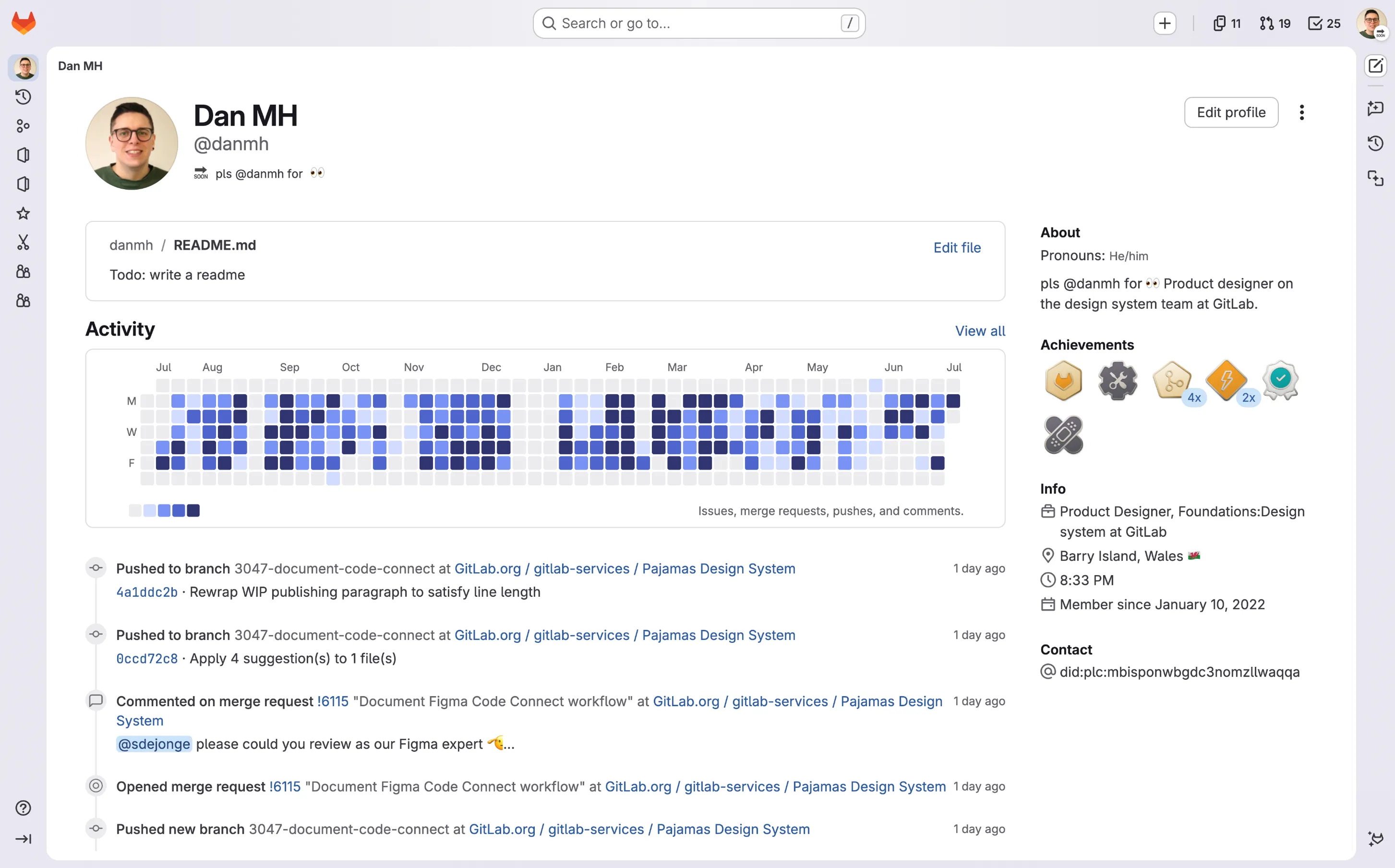
The numbers speak loudly…
- commits
- 1,525
- merge requests
- 523
- reviews
- 695
2022
2023
2024
2025
2026
… but they don’t tell the whole story.
Work can never be the same.
My brain has been completely rewired.
If you want to go fast, go alone. If you want to go far, go together.
Proverb from Burkina Faso*
My time at GitLab was built around six values, CREDIT:
- Collaboration
- Results (for customers)
- Efficiency
- Diversity, Inclusion, and Belonging
- Iteration
- Transparency
These values were more than words on a page. Beyond an onboarding checklist item. They were signed into our contracts as something to abide by and uphold. The values were everything. They showed up in the work, and in the product and company we were building.
When I joined the team in 2022 I thought I knew how to be transparent, collaborative, and iterative — helping others, asking for help, sharing as much as possible, breaking work down — these were all things I was practicing already. But at GitLab I found people who lived these in a different way, even when it cost something. They invited me in. I got to be part of it. I couldn’t imagine how powerful it would be when everyone meant them. Together.
That togetherness was focused on a simple and compelling mission: everyone can contribute.
I saw it in action in so many different ways: Start with an MR. Short toes. No ego. Be kind. Don’t pull rank. Say sorry. Do it yourself. Dogfooding. Say why, not just what. Reproducibility.
Open source is incredible; it is generous; it is the best of humans and software. GitLab itself is open core, encouraging contributions from everyone. I loved pairing with contributors who were not GitLab team members. Getting to share in folk seeing their first contribution merged is such a privilege.
I remember Product Designer Mike Nicholes would often say “contributions are a gift”. Gifts mark significant milestones. They can be something you’ve asked for. Often they are thoughtful. Sometimes they are unwanted or unsuitable. I learned to be at peace with this, remaining grateful and appreciative even when a gift couldn’t be used the way its giver had hoped.
I was also able to contribute a ton. I contributed to frontend, backend, tooling, scripts, docs. Shepherded by thoughtful, caring, kind, and patient colleagues. Contributions that other orgs would argue a designer has no right to make. Here it was welcomed.
I was motivated by the mission. We were held together with our shared values.
Here are some of my favourite ways work would happen:
Using the product to build the product is a wild flywheel. Dogfooding, or eating our own dogfood, meant we would feel the pain of friction and bugs fast. Using your own work felt awesome. Seeing the impact of your solutions in your colleagues’ work first was incredibly satisfying.
If you found something broken, you were expected to fix it before you moved on. Something missing? Document it. A dead link? Repair it. An opportunity for improvement? Capture it. This campsite rule of leaving the world a better place creates fantastic side quests for squirrel-brained folk. Combine this with healthy incentives and it creates a culture that optimises for the whole company, rather than any individual targets or tasks. If you mend what is broken, everyone who follows behind you will be more efficient and have a higher chance of success. This acts as a force multiplier and creates incredible leverage. At GitLab the incentives were there, and this glue work was rewarded by leadership and acknowledged and appreciated by team members.
I am rarely without an opinion. My takes have been known to be spicy (🌶️🌶️🌶️). Thankfully collaboration is not consensus. Disagreement was never a blocker. You could raise concerns, have them heard, and still let the decision move forward with full support of the team.
Most decisions were two way doors — reversible and low stakes if we got it wrong. Naming them let us act without waiting for input, and change direction when new information became available. This was a huge speed and efficiency unlock… as long as you wrote it down and kept it open.
I learned async is more than sending well crafted messages or recording video walkthroughs. It’s about creating space for everyone’s input to be heard, however they communicate best, and capturing it for both the short and long term. It allowed our best work, informed by all our quirks and atypicalities because we were able to show up with deeply considered views and perspectives. And later, re-evaluate or re-commit to those decisions.
Transparency is putting everything out there, making it findable, and creating a path for others to follow to understand your conclusions. Broadcasting meetings to YouTube felt scary, having my full work history visible to the world left me feeling exposed. I learned to love the light. It provided a safety I wasn’t expecting. Regularly I would find a comment that answered my question, thoughtfully put there by past me for future me to find.
I benefitted from GitLab’s openness before I joined, and others have told me they’ve benefited from the openness of the work. When I found the GitLab handbook sometime in 2019 I could not stop referencing it. The product development flow inspired ideas and answered questions I had about how teams could work together.
At no point did I believe someone like me could ever work at a place like that.
But representation matters, even in the small things. Seeing Max Woolf — who had some shared employment history — post about working at GitLab in a community slack gave me the tiniest grain of hope. If he could do it, what if I could as well? Pedro, Blair, Valerie, and Orit brought me in. Some of the rest you’ve just heard. Thank you for taking a chance on me.
Here’s an excerpt from my application cover letter:
I’ve rewritten this sentence countless times, but I just wanted to say thank you for being so open with your work. I have often referred to your company handbook and used it as my own when I am not sure what to do. It has been a massive benefit and massively shaped my thinking of how a mature UX function operates interwoven with development.
The benefits continued to be massive, and my thinking continued to be changed.
But for now it must come to an end. Thank you past and present people of GitLab for making it the best.
P.S. If you are values and mission driven I am open to work. Let’s build something together.
* The origin of the phrase is contested, if you want to read more https://andrewwhitby.com/2020/12/25/if-you-want-to-go-fast/
On Bluesky
Discuss on Bluesky →- Likes
- Reposts
- Replies